An Art Critic Shares the Place He Experienced a Strong Dose of Beauty ââ†and Became Undone
from the Invitee Editor
By Marek Bartelik
This special result of the Brooklyn Rail introduces AICA (the International Association of Art Critics), founded in Paris as a non-governmental organisation affiliated with UNESCO in 1949, to a broader audience in the United States and elsewhere.
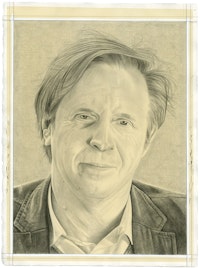
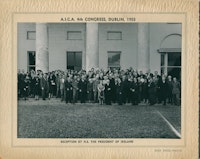
Unfolding the Archives of James Johnson Sweeney
by Marek Bartelik
A large white envelope addressed to the headquarters of AICA International at 32 rue Yves Toudic, 75010 Paris, stamped "Documents only," was mailed from New York on April 27, 2010. Last March, during my visit to the French majuscule to attend our annual administrative coming together, I constitute that envelope on a bookshelf in our function, stuck between two exhibition catalogues.


Peripheral Gaze in the Centre of Everything
By Leena-Maija Rossi
For starters, I take to confess that equally a European art professional I am aback of how niggling I know about European art criticism, and even European gimmicky art at big.
Recollections from the Congresses
By Anda Rottenberg
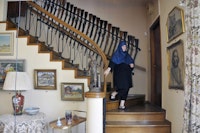
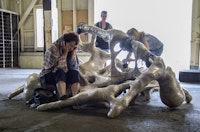
Distinguished Shine art historian, professor Juliusz Starzyński, one of the five founders of the Smooth department of AICA in 1955, came upwards with the subject and the program of the 1975 AICA Congress in Poland.

My Expanding Photograph Anthology
Past Marek Bartelik
"Art is the virtually intense mode of individualism that the world has known," (Oscar Wilde). AICA is nearly individuals, who happen to exercise fine art criticism.
AICA in Europe
By Kim Levin
This was the summer earlier the Velvet Revolution: Vaclav Havel was in jail, Jan Urban was riding effectually on a cycle in disguise, men in trench coats were threatening to shut downwardly the exhibition. My outset trip behind the Iron Drapery was surreal and fascinating.
Portugal
Report from Portugal
Past Lígia Afonso
There is significance in the number of events in Portugal that are focused on the area of artistic cosmos, which is one of the preferential fields of product in contemporary art. I could imagine an artwork empty, considering its temporal synchronicity, but that rarely happens.

Portugal
Susana Gaudêncio interviews Lígia Afonso
Art critics are now coming from areas such as journalism, music, philosophy of aesthetics—areas that could let for a greater complexity of references and arguments concerning the art object.
Ireland
Report from Ireland
By Ciarán Bennett
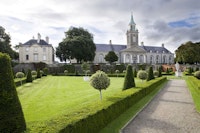
When James Johnson Sweeney curated the first international exhibition of late Modernism hither in 1967, which later became known as ROSC, he decided not to include any art from Republic of ireland subsequently 800 A.D. He was attempting to reconnect the island to the ancestral visual civilizations on the continent of Europe, every bit a different starting point than the late modernism inherited from a contested and all too problematic colonial history.
Ireland
Questions by Alan Phelan to Ciarán Bennett
I would similar to say that there is a direct line of literary brilliance between Baudelaire as the get-go modernist art critic and poet, and Derek Mahon, the most significant Irish gaelic poet of the second role of the 20th century.
United kingdom of great britain and northern ireland
Criticism: a U.Yard. perspective
By Sarah Kent
Recently, I served on the jury of the coveted London-based Arts Foundation Award for arts journalism and it was a sobering feel. I was shocked not just because the quality of the writing was and then loftier, merely because of the frustration expressed by many of the applicants and the air of agony that emanated from their submissions.

United Kingdom
x Questions
From Phyllida Barlow for Sarah Kent
Critics perform various tasks from reviewing exhibitions, to writing monographs, delivering lectures, and contributing essays to books and catalogues. In each case, the constraints differ, but favorable comments are generally more welcome than negative ones and in some cases are obligatory.
Spain
Contemporary Art Criticism in Espana: A Recent History Survey
By Javier Montes
The present situation of art criticism and the whole contemporary fine art ecosystem in Espana can merely exist well understood in the wider context of the development and development of Spanish media-related art criticism during the last 35 years.
Catalonia
Catalonia:
Art and Idea in Difficult Times
By Joan K. Minguet
The mass demonstrations and political actions of a big function of the Catalan population accept set in motion a process to allow citizens to vote on whether Catalonia will gain independence from Espana and becomes established every bit a new European state.
French republic
Raphael Cuir Interview by Tania Mouraud
translated from the French by Nick Irvin
Today, we have perhaps lost sight of the central issues of art criticism. With the weight and importance of the art marketplace, nosotros are expected to believe that nosotros no longer need criticism. In fact it's entirely the contrary.
Luxembourg
Cantankerous-over for the Luxemburgish Art Scene
past Lucien Kayser, translated from the French past Claude Colomer
In 1995, the city of Luxembourg was the European Capital of Civilisation. The following year, a edifice situated in the city eye was refurbished to host, from then on, the Casino Luxembourg – Forum d'art Contemporain, and, equally early as 1998, the Manifesta 2 events.
Luxembourg
On Criticism
Sophie Jung with Lucien Kayser
For every bit long as aesthetics was kept within strict limits, say until the terminate of the 19th century, when works had to comply with a set of rules, a proper canon inherited from the Greek platonic of beauty with equivalent values for both truth and justice, criticism was (only) the fine art of judging, of giving an stance most compliance.

Switzerland
The Swiss Art Scene and the Role of the Art Critic
By Patrick Schaefer
To map the situation of the artistic product in Switzerland in relation to the art critic, you could limit the survey to publications in newspapers, dailies, weeklies, monthlies, and quarterlies. It is more than relevant, though, to adopt a wider point of view, looking at all the institutions, associations, and galleries that support contemporary art.
Switzerland
In Conversation:
Philippe Fretz with Patrick Schaefer
As far as I am concerned, I prefer to describe an exhibition and highlight its distinctiveness. Unfortunately articles are very often written before the opening of the exhibition, so that they have to be general rather than content specific.
Italy
Study from Italian republic
Past Anselmo Villata
Italia is one of the countries richest in creative heritage: information technology is an unequalled resource, something that has become part of the cultural Dna with the potential to lend tremendous vitality to the present. At the same time, at that place is a run a risk of this by condign a burden.
Italy
Jorrit Tornquist interviews Anselmo Villata
Certainly we often tend to analyze specific problems concerning art and its production not only considering we have reached a very high and refined level of research from the artistic side and analysis from the critical side, simply likewise considering of the corporeality of information we receive from this world, which today has become extremely wide and varied.

Federal republic of germany
Artist Katya Gardea Browne Interviews Critic Ludwig Seyfarth
Information technology's difficult to give a general respond to this question. Mainly I like art that is concerned with the real problems of the world, that shows a personal viewpoint and has an emotional impact. I besides think all good art has to be convincing in its form and aesthetics.
Denmark
On the Danish Contemporary Art Scene and Art Criticism
By Lisbeth Bonde
The last fifteen years have been described as one of the richest periods in the history of Danish art, a new "Golden Age" of talent and expression that is garnering increasing attention from the global art world. Only regrettably the visual fine art is more and more invisible in the mass media.
Norway
Fine art Criticism in Norway
Past Dag Solhjell
Art criticism is always performed within a certain context. I will therefore start this overview with a short presentation of the Norwegian art globe, before addressing the activity of art criticism.
Kingdom of norway
Between Lotte Konow Lund (creative person) and Kjetil Røed (critic)
Commonly, ane tends to say that it is about distinguishing between good and bad; man, that is imprecise. Art criticism is about examining why the fine art works or not. An "exemplary consumer"—in the sense of existence a model—is another name I have given to the part of the critic.

Sweden
Report from Sweden
Past Ulrika Stahre
In late March a foreign letter of the alphabet was sent to a couple of culture editorial offices in Stockholm. It claimed to be written by the street artist Banksy, and appear his presence near the gallery cluster on Hudiksvallsgatan [known equally Stockholm'southward Chelsea] in the northern part of the inner city.
Sweden
Annica Karlsson Rixon interviews Ulrika Stahre
Sometimes I feel that I am terribly shut to imitating that kind of "art walk" common several decades ago. Then I tell myself to quit. And sometimes the slightly introspective criticism of the '90s dwells somewhere in the back of my head, enervating attention.
Republic of finland
Looking at the Bright Local Art Scene through the Huge Alter of the Media
By Marja-Terttu Kivirinta
This winter and jump in Helsinki there have been shows, by and large featuring local artists. They lasted three to four weeks. They have included museum exhibitions of internationally recognized artists, such as Alfredo Jaar, presented at Kiasma, and Jean Tinguely, at the Amos Anderson Fine art Museum.
Republic of finland
Photographer Jaakko Heikkilä with Marja-Terttu Kivirinta
I have written criticism for more than 30 years. Although the thought of art criticism is still the same—it should be analytical and disquisitional—during that period the reviews have changed. And now I talk about newspaper journalism, my professional background.
Poland
The Electric current Land of Art Criticism in Poland
By Dorota Jarecka
The famous Polish author Tadeusz Konwicki once said that there is simply one section of the newspapers that is more tiresome than obituaries—the art reviews. This is not to say that he was not interested in art.
Poland
Katarzyna Kozyra with Dorota Jarecka
To be an fine art critic is to assume an authoritarian position. The whole idea of making judgments is based on power, which is typical for modernity. And I think that the office of an fine art critic is dying down only considering modernity is dying down. Tin can a critic'southward use of power verge on abuse?

Slovakia
When We Idolize Art
Past Richard Gregor
Art criticism in Slovakia is arguably reminiscent of a laboratory in which private experiments, contained of each other, are pretty much anticipated based on an awareness of the evolution and patterns of critical thinking and how it is put into practise in Western countries.
Slovakia
Juraj Čarný with Stano Masár
I define and re-define the criteria over the form of my curatorial preparations for an exhibition. The beginning of my curatorial work was linked to an absenteeism of gallery institutions, in Bratislava specially, and Slovakia in general.
Hungary
Hungary—A Post-Socialist Conflict Zone
By Edit András
After the election in Hungary, carefully tailored to exist favorable for the ruling party, zip can end FIDESZ, a conservative, right-wing political party, from completing the creation of a retrograde, ethno-nationalist state-system with semi-feudal, semi-socialist features, the foundation of which had been laid downwardly during the previous 4 years.
Croatia
Report from Croatia
By Branko Franceschi
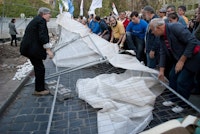
Among Croatia's 4.26 million citizens, weary from the long economical crisis, the widespread opinion is that visual art is i of the nation's most successful cultural exports.
Croatia
Kata Mijatović with Branko Franceschi
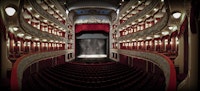
Art has e'er had the aforementioned function, from the offset of time until the nowadays. I remember of fine art as a form of cognitive activity that reflects how we resonate with the universe and, of class, society through symbols and visual codes. That is the office of art in its existential sense—it helps the survival of humankind.

Rep. of Macedonia
Study from Macedonia
On a City between two "spectacles"
Past Mira Gakina
Skopje, the Macedonian capital, has drawn global attention twice over the last fifty years—the offset on account of the devastating earthquake in 1963 in early days of tv set, and again recently with the controversial project Skopje 2014. These ii events have been crucial for both the development of arts and the quality of urban life.

Rep. of Macedonia
Velimir Zernovski interviews Mira Gakina
Nosotros are in a hole for survival, nosotros hide from a "great danger." You lot are solely interested in this moment. Transition is hither, commenced a long time ago in the very circuitous conditions of a protracted and painful dissolution of the Yugoslav system.

Hellenic republic
Polyna Kosmadaki with Danae Stratou
As an artist, it is not often that I take the opportunity to be the one asking the questions and so, when invited by Marek Bartelik to participate in this special issue of the Brooklyn Track, in which artists get the hazard to "interrogate" those who write virtually our fine art and enquire united states questions about information technology, I jumped at the opportunity.

Bulgaria
At the Finish of The Longest Decade
By Svetlana Kuyumdzhieva
Bulgarian fine art has been going through a retrospective period in the by few years, a phase that comes across as overly cornball when compared with the 1990s. And indeed it looks every bit though the '90s are withal here.
Romania
The Art Scene and Fine art Criticism in Romania
By Adrian Guta
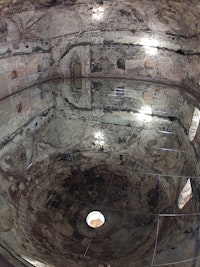
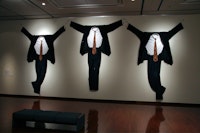
In comparison with the Communist era, the 25 years of regained freedom of expression in Romania accept brought major changes to our art scene. There were phases of this process: the '90s differ from what came after 2000. Throughout these phases, diverse evolutions take contributed to defining a remarkably complex visual civilization.
Romania
Creative person Iosif Kiraly Interviews Critic Adrian Guta
I first felt attracted to art criticism when, as a educatee in my final year (1978 – 79), I was asked to notice the development of the diploma projects of colleagues in the painting, sculpture, and graphic arts departments—I eventually chose graphic arts—and to write an essay with my conclusions.
Ukraine
Kiev, April 29, 2014
Past Larissa Babij
Today it is incommunicable to talk about Ukraine without acknowledging the Maidan protests. Making art about Maidan seems logical, even lucrative, simply I am suspicious of exhibitions and objects being produced at present that merits to be administrative reflections of events that are and so fresh in our collective retentiveness and have not yet reached whatever conclusion.
Turkey
The Contemporary Art Scene in Turkey
Past Burcu Pelvanoğlu
Ii channels offer insight into the evolution of contemporary art in Turkey. The commencement is the bear upon globalization has had on the Turkish fine art scene; and the second, the transition between social sciences and art in the context of postmodern discussions.

Russia
The Bodily Art Scene in Russian federation
By Andrei Tolstoi
The current art scene in Russia could be characterized as one with many unlike modes of artistic expression. Hither, many institutions are specifically focused on research and organizing exhibitions of gimmicky fine art.
January half dozen, 2004
By Martin Gayford
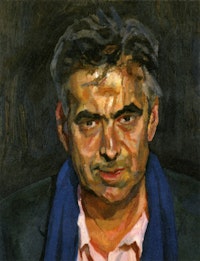
I begin to feel a slight apprehension as to what this film will look like. Will I expect ugly? Will I wait erstwhile? Facing up to the facts of life, such every bit aging and bloodshed, are precisely the point of Lucian Freud's blazon of painting—of course, nosotros applaud it in Rembrandt, but I am not sure how I feel about the policy when it is applied to myself.


Source: https://brooklynrail.org/special/ART_CRIT_EUROPE/

Enregistrer un commentaire for "An Art Critic Shares the Place He Experienced a Strong Dose of Beauty ââ†and Became Undone"